
Sources for South Gate Previous Residents
A South Gate house history needs an era table before it needs a name search. The county deed index begins in 1850, but a present parcel can have a different street number, tract label, or legal description than an older source. The assessor Events History supplies document numbers for some parcels. Directories and census schedules add the people who occupied an address, while permits and maps explain changes in the built record.
Access is spread across online portals, public counters, requests, library staff, and historical collections. The source column tells what a result can establish, so previous residents are not inferred from a single ownership field.
| Source | Years it covers | Where held | What it shows |
|---|---|---|---|
| Recorder index and deed books | Los Angeles County from 1850 | RR/CC request, counter, mail, fax, terminals | Grantor, grantee, transfer date, legal description |
| Assessor Events History | Varies by parcel; inspected example reached 1977 | LA County Assessor Portal | Recording date and document-number bridge |
| Regional city and street directories | 1875 to 1987; South Gate inclusion varies | LAPL Visual Collections | Named occupant or business by address |
| Californiana and local history | Nineteenth century holdings; 1918 South Gate items shown | Norwalk and LA County Library | Directories, census, photographs, newspapers, early residents |
| Federal census | Through 1950 public in 2026 | NARA and library partners | Household members, relationships, ages, occupations |
| Permits, probate, obituary | Coverage varies | City, LA Court, library, newspaper | Construction, death, relatives, estate clues |
Begin South Gate House History
Start with the current physical parcel, not a remembered owner. Search the Los Angeles County Assessor Portal by address or AIN. Save the AIN, situs, tract or lot, legal description, year built, use, values, and Events History document numbers. The public web portal does not supply a public owner-name search, so owner or mailing information must come through the assessor’s lawful service or counter route.
Read the mailing address carefully. It is the destination for a tax bill, not proof that a person lived at the situs. A trust, agent, manager, or owner elsewhere can produce a different mailing address. The parcel map also matters because a subdivision, lot split, or old street number can make a name search begin at the wrong place.
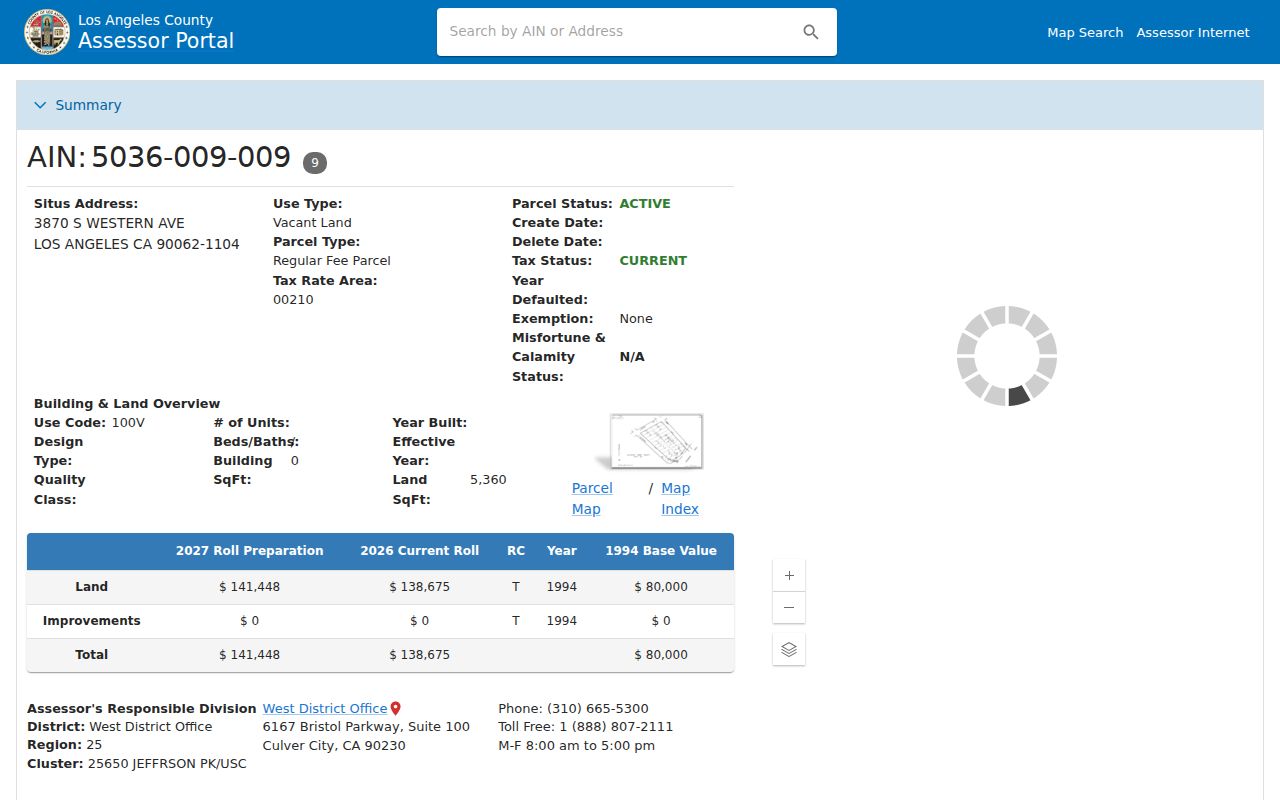
The sample parcel event history shows why a document number and recording date are more useful than a vague claim that a house has an old record.
Walk the South Gate Deed Chain Backward
Los Angeles County RR/CC records deeds, deeds of trust, reconveyances, liens, maps, and related instruments in alphabetical grantor and grantee indexes. There is no open Internet grantor or grantee name index. Use the assessor document number when available, or search the current party name through a Norwalk terminal, staff request, or record request.
- Confirm the parcel, AIN, situs, and legal description so an old address does not send the search to the wrong land.
- Obtain the current owner through the assessor’s lawful channel and identify the acquisition document from Events History or RR/CC.
- Read the deed for the grantee, grantor, recording date, document number, and legal description.
- Search the grantor backward as a grantee, narrowing the date range to before the transfer.
- Repeat until the index, book, or map requires counter retrieval. Describe that transition accurately because the official pages do not publish one online image cutoff.
- Grantor
- The party transferring an interest in the recorded instrument.
- Grantee
- The party receiving the interest in that instrument.
- Chain of title
- A sequence of recorded ownership transfers for one parcel.
- Legal description
- Tract, lot, block, or related land language that anchors the parcel.
South Gate Events History Number
An assessor Events History row can include recording date, sequence, reassessed flag, document number, ownership or change codes, document type, document reason, parcel count, percentage, verification code, documentary transfer tax sale price, and assessed value. An inspected example reached back to 1977. That depth varies by parcel, and the event row is not the deed image.
Use the document number to request the actual RR/CC instrument. The deed supplies the legal parties and terms that a parcel event summary cannot. If the event number does not resolve, keep the recording date and legal description and ask the recorder about the index or book and page route.
Note: An assessor event is a bridge to a recorded document, not a complete chain of title.
South Gate Ownership Is Not Occupancy
A deed chain can establish previous owners without naming everyone who lived in the house. A directory may list a family member, a boarder, or a business at the address. A census records the people present on its enumeration date. A permit names the person who applied or performed work. Those sources may overlap, but the role printed in each record controls.
Use cautious language: “owned during this period,” “listed at the address in this year,” or “named on the permit.” A past owner may have moved before a sale, while a household may have remained after title changed. The distinction is the heart of previous residents research.
Helpful boundary. A deed proves a recorded transfer. It does not create a complete occupant roll or confirm who is present today.
Regional Directories Show Past Households
The Los Angeles Public Library’s digitized Los Angeles-area city and street directories span 1875 to 1987. The alphabetical entry can show name, spouse notation, occupation, employer, and address. The street-order section reverses the query, placing an occupant or business under a number. Search South Gate and Hollydale, then inspect the image because OCR and locality headings can fail.
A missing year is not proof that a household left. Coverage, omission, a move, a death, a new street label, and a skipped publication year can all produce a gap. The collections and reading method are covered in the South Gate city directory book; the address chain remains the focus here.
Pair 1950 Census with Directory Years
The federal census supplies a household snapshot that a deed cannot. In 2026, 1950 is the newest public population schedule under the 72-year release rule. Pair a directory year near 1940 or 1950 with the matching census, then compare street, enumeration district, names, relationships, ages, and occupations.
Directory publication and census enumeration do not occur on the same day. A household can change between them. Use an obituary or probate filing to test a death, and use a deed or permit to test a move, sale, or rebuild. Keep the source date beside every conclusion.
- Find the address in a directory year and copy the street section and alphabetical entry.
- Locate the same street and enumeration district in the released census.
- Compare the household members and occupation without forcing spelling to match.
- Use a later directory or an obituary to test what changed after the census date.
Permits Date South Gate Construction, Not Move-In
South Gate’s Online Permit Counter and Building and Safety records can show project status, plan checks, inspections, owner-builder or contractor details, financial data, and work dates. A final inspection dates a construction milestone. It does not prove that a household moved in on that day.
The 1933 Long Beach earthquake damaged local buildings and killed five people. Repair permits, photographs, newspapers, and assessor effective-year fields can therefore explain why a home’s physical history looks different from a simple ownership chain. Treat a permit as a building clue and compare it with the directory and census record.
Marriage Records Mark a Family-History Endpoint
When a previous residents trail moves from one household to another, a marriage record, obituary, or probate case may explain the relationship. Los Angeles County marriage records reach 1852, and the RR/CC offers county copy routes with separate eligibility, delivery, and fee rules. A marriage copy can support a family link, but it does not prove that the person occupied a particular South Gate address.
Use the library, death index, and newspaper source to form a lead, then request the official record when the date or relationship matters. Probate petitions and notices can add heirs or address clues, while sealed or confidential material remains unavailable.
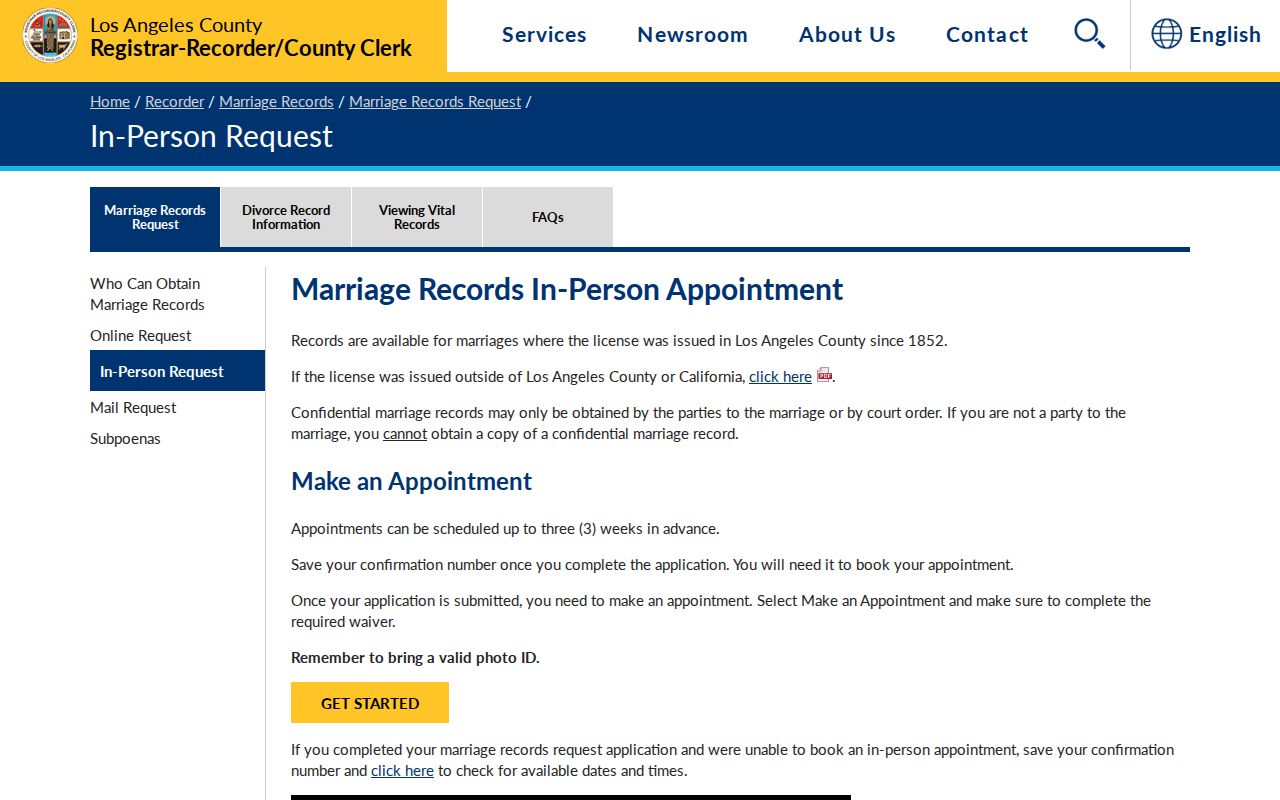
The marriage-record route shows how an official family event can help explain a household transition without being mistaken for an address directory.
South Gate Gardens and Hollydale
South Gate Gardens promotion began in 1917, incorporation followed in 1923, and Hollydale kept a separate local identity after early annexation. An older deed, newspaper, directory, or photograph may use one of those labels instead of modern South Gate. Search the alternate place name and preserve the original wording in the research notes.
Tract and lot language can be more stable than a street number. Use the AIN, parcel map, legal description, and map references to connect a historic source to the current parcel. This is especially important when a prior resident’s address appears before the present street grid was fully built out.
| Continuity clue | Why it helps |
|---|---|
| South Gate Gardens | 1917 tract-promotion language before incorporation. |
| Hollydale | Neighborhood identity that persists in maps and local history. |
| AIN | County parcel bridge across map, tax, and deed systems. |
| Tract and lot | Legal land reference when address wording changes. |
South Gate’s Backward Trail Has Privacy Limits
Historical house research is for family history, property history, and personal curiosity. Current protected addresses may be hidden through Safe at Home, voter protections, sealed court files, confidential adoption records, or other statutory limits. A missing name is not proof of a move, a death, or a problem with the record.
Return corrections to the custodian. The assessor handles roll questions, RR/CC handles recorded and county vital records, the court clerk handles case procedures, and the library can explain historical holdings. A current person should not be tracked by combining sources that were designed to protect them.
Lawful house history. Use previous-resident records for a documented property or family question. Stalking, harassment, intimidation, and attempts to bypass confidentiality protections are unlawful.